
VIN Lookup in Kansas gives instant access to vehicle history, title status, and registration records through the state’s online portal. By entering the 17‑digit VIN you can run a VIN search, VIN number lookup, or vehicle identification number lookup that reveals ownership changes, accident reports, mileage logs, and recall alerts. The system also supports VIN decoder features, VIN verification, and VIN database search, helping buyers confirm a vehicle’s true condition before purchase.
VIN Lookup also powers a fast VIN number search for title verification, theft checks, and salvage status. Users can quickly find vehicle records, VIN information, and VIN history by number, uncovering details like model year, engine type, and plant code. The Kansas Department of Revenue’s VIN lookup online tool integrates VIN decoding with VIN record accuracy checks, ensuring you see the full story behind any vehicle you consider.
How to Search VIN Lookup
A VIN lookup matches a vehicle identification number with the records held by the Kansas Department of Revenue, Division of Vehicles. A VIN number lookup helps you confirm title and registration status, compare a vehicle’s identity with its papers, and find problems before a purchase or a title transfer. You can also visit sedgwick county ks for broader county resources. The state portal covers title and registration records. Accident, theft, and recall checks come from other official sources covered below. Using the same 17-character number for every check keeps every result tied to one vehicle.
Official Search Portal: https://www.ksrevenue.gov/dovtitle.html
Steps to Search
- Open the Kansas Department of Revenue Titles and Registration page and choose the vehicle record search option.
- Enter the 17-character VIN in the VIN field. Type the letters and numbers exactly as they appear on the vehicle, with no spaces, dashes, or extra characters.
- Submit the search and read the record that appears for the vehicle.
- Compare the listed make, model, model year, and title or registration status with the vehicle and its documents, and note the date shown on the result.
- If the record does not match, check for typing errors and confirm you copied all 17 characters. Contact the Titles and Registration unit listed at the end of this page when the mismatch remains.
VIN Search Methods for Kansas Vehicle Records
Most Kansas vehicle record searches begin with the VIN alone. Some searches work better when the plate number or the title document sits close by. The method below shows where to read the VIN, how to check it for typing errors, and what to gather before you begin.
Locate the 17-Character VIN
The VIN is a permanent code that stays with the vehicle for its life. It is not the same as the license plate, which can change when a plate is replaced or when the vehicle moves to another state.
Most passenger vehicles carry the VIN in two places: on the driver’s side dashboard near the windshield, and on a label inside the driver’s door frame. A door-jamb label often lists make, model, model year, and engine next to the number. Some vehicles also have a label under the hood or on the body, and certified vehicle and replacement-parts labels can carry the same code. Motorcycles, all-terrain vehicles, and other classes place the number in different spots, such as on the steering head or frame. Trailers place a VIN on a frame rail. Read the number from the vehicle rather than from a seller’s online listing, since a listing can hold a copied or mistyped number.
Validate the VIN Format
A standard VIN has 17 characters. Each character is a letter or a number, and the code never uses the letters I, O, or Q. Spaces, dashes, and symbols have no place in a search field. Leaving out those three letters reduces the chance of mixing a zero with an O or a one with an I.
For vehicles built in North America, position 9 holds a check digit. A math rule built from the other characters produces it, so a mistyped number often creates a mismatch. The check digit catches typing errors, yet it does not prove that a VIN is genuine. A number copied from the wrong document can still pass the math test.
Vehicles built outside North America follow the same 17-character layout with a different use for position 9. Vehicles sold in the United States usually follow the North American pattern, so an unusual character in position 9 on an imported vehicle may not signal a bad number.
Required Details for a Reliable Search
Keep these items close before you search:
- The full 17-character VIN read from the vehicle itself, not from a listing or advertisement.
- The title or registration document, so you can compare the number printed on the paper with the number on the vehicle.
- The plate number and the state that issued it, if the search form offers a plate field.
- The odometer reading taken from the dashboard.
- The names of any lender listed on the title, so lien records can be matched.
- The purpose of the check, such as a Kansas title transfer, a registration renewal, or a purchase review.
VIN Structure and Decoding
VIN decoding reads the meaning behind each character. The layout follows an international standard for vehicle identification, and North American manufacturers file the code definitions that make decoding possible. Decoding gives factory details, which makes it useful for spotting a number that does not belong to the vehicle in front of you.
World Manufacturer Identifier (WMI)
The first three characters form the World Manufacturer Identifier. The first character points to a country region, with 1, 4, and 5 used for North America, 2 for Europe, 3 for Africa, 6 and 7 for Oceania, and 8 and 9 for South America. The next two characters identify the manufacturer or a region within that country. In many North American WMIs, the third character points to a vehicle type or a maker’s division.
Because each manufacturer sets its own code, two similar-looking WMIs can belong to different makers. A decode result that names a different make than the badge on the vehicle is a clear reason to stop and check where the number came from.
Vehicle Descriptor Section (VDS)
Characters 4 through 8 form the Vehicle Descriptor Section. These positions carry maker-specific traits such as body class, engine type, model series, restraint equipment, or part of a trim designation. Each manufacturer chooses how to use them, so no single list translates every position for every make.
This section explains why two decoded VINs can share a WMI and model year yet differ in body style or engine. It also explains why a decoder often shows a broad body class rather than an exact trim name.
Vehicle Identifier Section (VIS)
Characters 9 through 17 form the Vehicle Identifier Section. For North American vehicles, position 9 is the check digit, position 10 is the model year code, position 11 is the manufacturing plant code, and positions 12 through 17 hold the production sequence number. The sequence number counts vehicles built at that plant under that model and year code, so it carries full meaning only with the maker’s own records.
Model Year Code and Manufacturing Plant Code
The model year code at position 10 runs through a fixed list that repeats every 30 years. A vehicle with a given code can be a 1995 model or a 2025 model, so the code alone cannot settle the year. Other characters, the date papers, and the build details settle it.
The plant code at position 11 often uses a letter, though its exact meaning comes from the manufacturer. Users can also reference person online lookup for additional information. Some makers share plant codes, and some codes cover more than one plant. Treat the plant code as a clue rather than a confirmed build address.
Vehicle Specifications You Can Review
Decoded specifications come from maker data filed with the National Highway Traffic Safety Administration and published through its vehicle data program. The official NHTSA VIN decoder at https://vpic.nhtsa.dot.gov/decoder/ shows factory descriptions for many North American vehicles. NHTSA also lists open safety recalls at https://www.nhtsa.gov/recalls. Decoder output describes the factory build, not changes made after the vehicle left the plant.
Make, Model, and Model Year
A decode result normally names the manufacturer, the model family, and the model year. Exact trim names, paint colors, and option packages rarely appear, since those choices sit outside the VIN. Some makers reuse a model name across several years, which means a decoded model year can differ from the year on the paper title without any mistake by the seller.
The door-jamb label and the title document carry the values for the vehicle you can inspect. Use the decode result to confirm the general identity, then use the labels to check the finer points.
Body Style and Drive Type
Body class codes come from a standardized list that includes labels such as sedan or saloon, compact car, pickup, and sport utility vehicle or multi-purpose vehicle. These classes describe the shape of the vehicle in broad terms. A truck may show only its cab and bed arrangement, and an SUV may not receive a name that matches the trim badge on the tailgate.
Drive type data can show front-wheel drive, rear-wheel drive, four-wheel drive, or all-wheel drive, and some makers add axle and drivetrain codes for trucks. Older vehicles often have no drive type in the decoded output. Codes for electric and hybrid versions differ from the gasoline models, so a mismatch on a powertrain point deserves a check against the charge port, fuel door, and badges on the vehicle.
Engine and Transmission Details
Engine fields may list displacement, cylinder count, fuel type, and rated output, with battery details and electric range for battery-powered vehicles. Transmission fields often name the style, such as automatic or manual, and the number of gears. Some vehicles carry two powertrain codes, which lets one VIN cover a hybrid and a plug-in version or a gas model and an electric one.
Many VINs do not decode every engine field. Older vehicles and some makers with thin filings return little or nothing for horsepower or transmission detail. Engine swaps are a frequent reason the decoded engine fails to match the engine bay, so treat that mismatch as a prompt to inspect the vehicle rather than as a clerical error.
Vehicle History and Title Records
A state record and a vehicle history report answer different questions. The Kansas portal shows title and registration facts for vehicles in the state’s system. A paid history report draws from state files plus insurance, repair, and commercial sources, so it can show events the state page does not list. A full used vehicle VIN check draws on both.
Registration and Ownership History
A Kansas vehicle record can show registration standing, plate data, and the title activity the department publishes. Public results often show the current holder and a shortened history instead of a full ownership timeline. A history report can list each transfer with dates, states, and mileage, which gives a clearer picture of how long each owner kept the vehicle.
Compare the two timelines against each other. A large odometer jump between transfers can point to a mileage problem, and a transfer that appears in the report but not in the state record may simply be a record that has not loaded yet.
Accident and Damage Records
Most accident data reaches a buyer through insurers and repair facilities rather than through a title page. History reports may list accident entries, damage entries, and sometimes service records. An accident entry ties to a reported crash. A damage entry can describe repair work reported through other channels, including hail, flood damage, or frame work. Providers label and sort entries differently, so the same event can look different from one report to the next.
Salvage, Rebuilt, and Other Title Notations
States place a notation on the title when a vehicle is declared a total loss or restored after such a declaration. Common terms include salvage for a vehicle declared damaged beyond repair, rebuilt for one restored after that declaration, and flood for water damage. Kansas records can carry notations such as salvage or rebuilt, and those notations stay with the vehicle for its life. They can change the value and the insurance terms a buyer receives.
A rebuilt title does not by itself mean the vehicle is unsafe. It means a buyer should learn why the status was given, request the repair records, and price the risk rather than the badge.
Recalls and Theft Checks
NHTSA’s recall lookup takes a VIN and returns open manufacturer safety recalls. The results cover safety recalls rather than every service bulletin, so a clean recall result does not mean the vehicle received every recommended repair.
For theft, NICB’s VIN Check searches vehicle identifiers against national theft records, and law enforcement can confirm a report on file. You can also consult address information to locate official filings. A clear title record does not clear a stolen vehicle, since a theft report may not have reached the state system. If a seller cannot produce keys, title papers, and a matching VIN, stop and contact the police.
Checks Before Buying a Used Vehicle
A pre-purchase VIN check takes a few minutes and can prevent a costly mistake. The order matters: start with the vehicle, then compare it to every paper, then look for gaps in the history. A used car VIN lookup works best when you read the number yourself rather than accepting the seller’s copy.
Match the Vehicle to Its Records
Read the VIN from the door-jamb label and compare it with the title, the registration document, and any window sticker. All 17 characters should match, including the check digit. Then compare the make, model, model year, body style, and engine with the decoded result. A single mismatch deserves attention, because cloned VINs and swapped paperwork both show up this way.
Verify Mileage and Condition
Compare the odometer reading on the dashboard with every mileage entry in the history report and with the disclosure on the title paperwork. Look for a sudden jump, a rollback, or a reading that does not fit the vehicle’s age. Note the date of each mileage entry, since an old report may miss recent driving.
Check Title, Lien, and Registration Status
Read the title notations for salvage, rebuilt, flood, or other brands before you discuss price. Confirm the seller holds the title and that any lender listed has released the lien. For a vehicle titled in Kansas from another state, the department may ask for a VIN verification, which is a physical inspection of the number on the vehicle by an authorized person who matches it to the paperwork. The Titles and Registration unit can confirm what a specific case requires.
Pre-Purchase VIN Checklist
Run through this list before you sign anything:
- Read the VIN from the vehicle and compare it with the title, registration, and window sticker.
- Compare the decoded make, model, model year, body style, and engine with the badges and labels on the vehicle.
- Compare the dashboard odometer reading with each mileage entry in the history report and with the title disclosure.
- Review title notations for salvage, rebuilt, flood, or other brands.
- Ask for service records that match the vehicle, not a copy belonging to another VIN.
- Run a stolen vehicle check and confirm the seller can produce keys and proof of ownership.
- Request written confirmation of the sale price, the VIN, and any title condition before money changes hands.
- Walk away and contact law enforcement if the seller refuses a VIN check or the number changes between visits.
Record Accuracy and How to Resolve Problems
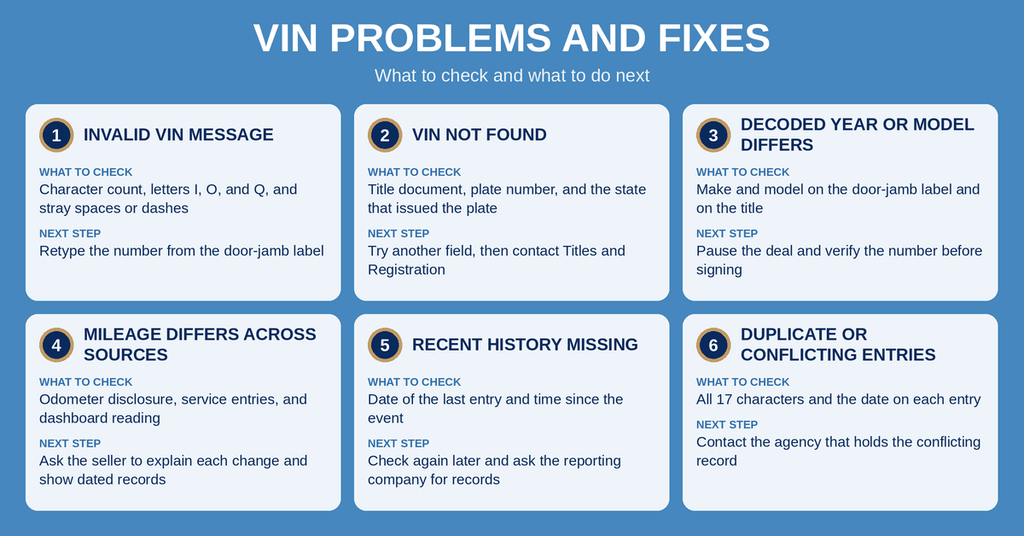
A missing record or a conflict does not always mean the vehicle has a problem. Agencies load data at different speeds, numbers get typed wrong, and public views show only what the record holder chooses to publish. Work through the issue in the order below so you can tell a clerical problem from a real discrepancy.
Invalid VIN and Not Found Results
Most rejected searches come from the number itself. A count of 16 or 18 characters, the letters I, O, or Q, stray spaces, and missing punctuation all cause a format error. Once the format passes, a VIN not found result often means the vehicle is titled in another state, was registered recently, or has no Kansas record yet. A number copied from a bill of sale or an online listing can also point to the wrong vehicle.
Update Delays
Title transfers, registrations, insurance filings, and repair records travel through separate channels. A new owner or a recent event may take time to appear in each place. The date on a result tells you how fresh the record is, so a result without a date deserves a phone call rather than a conclusion.
Conflicting Details and Duplicate Records
One vehicle can appear under two entries after a transfer, an import, or a re-registration, and each entry may carry different details. Compare all 17 characters and the date on each record. When the records disagree, the agency holding the conflicting entry can explain which one is current. For a purchase, request dated source documents from each source rather than relying on a screen alone.
Contact Information
If a title record does not match the vehicle, or you need guidance on title and registration records for a specific case, contact the Titles and Registration unit. Have the full VIN, the plate number, and any title document numbers ready before you call, so staff can pull the right record.
Frequently Asked Questions
Find quick answers about using a VIN lookup with the Kansas Department of Revenue, Division of Vehicles. These questions cover how the service works, what information you can get, and where to go if you run into problems.
How does a VIN lookup work in Kansas?
A VIN lookup matches the 17‑digit vehicle identification number you enter with the title and registration records stored by the Kansas Department of Revenue. The system checks the VIN against its database and returns the vehicle’s make, model, year, and current title status. It also confirms that the VIN on the vehicle matches the paperwork, helping you spot mismatches before a purchase or title transfer.
What can a VIN lookup reveal about a vehicle?
A standard Kansas VIN lookup shows the vehicle’s make, model, body style, engine type, model year, and the plant where it was built. It also displays the title status, registration state, and any branding such as salvage or rebuilt titles. For accident, theft, or recall details you will need to consult separate state or federal sources, but the basic lookup gives a solid starting point.
How can I check a vehicle’s title with a VIN?
Enter the VIN on the Kansas Department of Revenue’s online portal. The system returns the title record, indicating whether the title is clear, branded, or has liens. It also shows the last recorded transfer date and the name of the current registered owner. This information lets you verify ownership and detect any title problems before completing a sale.
Where do I find the Kansas VIN search portal?
The official portal is located at https://www.ksrevenue.gov/dovtitle.html. From the site, select the VIN lookup option and follow the prompts to enter the 17‑digit number. You can also call the Division of Vehicles at (785) 296‑3621 for assistance during business hours: Monday, Wednesday‑Friday 8:00 AM‑4:30 PM; Tuesday 9:00 AM‑4:30 PM.
What if my VIN is not found in the Kansas system?
If the system returns “VIN not found,” double‑check that the number is entered correctly, including all letters and digits. An incorrect character or missing digit can cause a mismatch. If the VIN still does not appear, the vehicle may be newly registered, imported, or the record could be missing. Contact the Division of Vehicles for further verification and to correct any errors.